
Your wedding morning sets the tone for the entire day, and the single biggest factor in whether that morning feels calm or chaotic is your timeline. A well-planned wedding morning timeline gives every person in your bridal party a clear window for hair and makeup, leaves room for photos, and still gets you to the aisle relaxed instead of rushed. Brides often underestimate how much time beauty services actually take once you factor in the whole group, and that miscalculation is one of the most common sources of wedding day stress. This guide walks through exactly how to plan a wedding morning timeline for hair and makeup, hour by hour, so you can walk into your wedding day feeling prepared instead of anxious.
At Chicago Bridal Artists, we build custom timelines for every bride we work with, because no two wedding mornings look the same. Group size, venue distance, ceremony time, and even the season all play a role in how your schedule should be structured. By the end of this guide, you will have a clear framework you can use to build your own wedding day beauty schedule, whether you are getting ready with two bridesmaids or a full party of ten.
Why a Wedding Day Beauty Schedule Matters
A wedding morning without a schedule tends to run long, and once it runs long, everything after it shifts too. Photographers lose their light, the ceremony starts late, and the bride ends up rushing through moments that should feel calm and enjoyable.
The Ripple Effect of a Late Start
One missed time slot in the morning rarely stays contained to that slot. If your hairstylist starts thirty minutes late because a bridesmaid overslept, that delay pushes into your own hair and makeup time, which then pushes into your first look, which then pushes into your ceremony. A written schedule keeps everyone accountable and gives your beauty team a clear structure to follow.
How Timing Affects Your Photos
Photographers plan their entire shot list around your hair and makeup finish time. If you are running behind, you lose the relaxed detail shots, the candid moments between you and your bridal party, and sometimes even portions of your first look. Our team at Chicago Bridal Artists coordinates directly with photographers whenever possible so beauty timing and photography timing line up instead of competing with each other.
How to Plan a Wedding Morning Timeline That Works
Building your timeline starts with one fixed point and works backward from there.
Start With Your Ceremony Time
Your ceremony time is the anchor for everything else. Once you know when you need to walk down the aisle, you can count backward through travel time, photography time, and getting ready time to land on a realistic start time for hair and makeup.
Count Backward From There
A simple way to build your schedule is to list out every event of the morning in reverse order, starting with the ceremony and working back to when the first person needs to sit in the makeup chair. This includes:
- Ceremony start time
- Travel time to the ceremony venue
- First look and bridal portraits, if scheduled
- Getting dressed
- Final touch-ups
- Hair and makeup application for the full party
- Hair and makeup for the bride, usually scheduled last so the look stays fresh
Working backward this way naturally reveals how early your morning actually needs to begin, which is often earlier than most brides expect.
Sample Wedding Day Beauty Schedule Hour by Hour
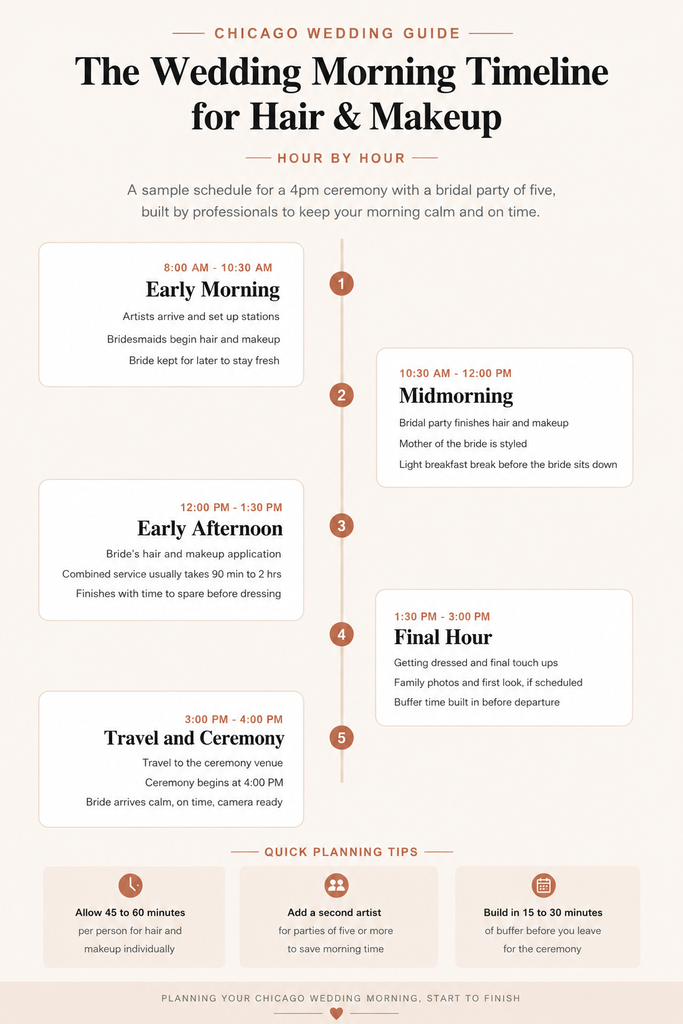
Every wedding is different, but a sample schedule helps illustrate how the pieces fit together. Here is an example for a ceremony starting at 4 in the afternoon with a bridal party of five.
Early Morning
Hair and makeup artists typically arrive around 8 in the morning to set up their stations, and the first bridesmaids usually begin around 8:30. Starting with the bridal party rather than the bride keeps the bride’s finished look as fresh as possible closer to ceremony time.
Midmorning
By 10:30 or 11, most of the bridal party should be finished with hair and makeup, leaving the late morning open for the mother of the bride, the bride’s own trial run touch-up, and a light breakfast break before the bride sits down for her own services.
Early Afternoon
The bride’s hair and makeup application usually takes between 90 minutes and two hours combined, so starting around noon leaves plenty of room to finish by 1:30 or 2, allowing time to get dressed and prepare for a first look or bridal portraits.
Final Hour Before Ceremony
The last hour before the ceremony should be reserved for getting dressed, final touch-ups, family photos, and travel to the ceremony space. This hour tends to move quickly, so building in a buffer here is one of the smartest things you can do for your schedule.
The infographic below breaks this same flow into a simple visual you can save or print, showing how each block of the morning connects to the next so nothing gets missed.
How Many People Need Hair and Makeup and Why It Matters for Timing
Group size is one of the biggest variables in any wedding day beauty schedule, and it is often where brides miscalculate their timeline.
Calculating Time Per Person
As a general rule, plan for about 45 minutes to an hour per person for hair, and a similar window for makeup, depending on the complexity of the style. A simple half-up style takes less time than a full braided updo, and a natural makeup look takes less time than a dramatic, full coverage application. Multiply this by your total group size, including mothers and any flower girls receiving services, to get a realistic total.
Using Multiple Artists to Save Time
If your bridal party is larger than four or five people, working with a single artist can push your morning start time uncomfortably early. Bringing in a second or third artist allows services to happen simultaneously, which can cut your total prep time significantly. This is especially helpful for weddings with a ceremony time before noon, where every hour of morning time counts.
Common Timeline Mistakes to Avoid
A few scheduling mistakes show up again and again in wedding mornings, and they are all avoidable with a little planning.
- Underestimating how long the bride’s own hair and makeup will take, since it is usually more detailed than everyone else’s
- Forgetting to schedule time for breakfast or snacks, which keeps energy up during a long morning
- Not accounting for hair extensions, veil placement, or accessory attachment as separate steps
- Scheduling the photographer’s arrival before the bridal party is even close to finished
- Leaving no buffer time between the last beauty appointment and departure for the ceremony
Avoiding these missteps comes down to building extra time into your schedule rather than planning it minute to minute with no flexibility.
You can see examples of past wedding mornings we have styled in our Chicago Bridal Artists portfolio, which shows the range of looks and timelines we have managed for brides across the city.
Building In Buffer Time
No wedding morning goes exactly according to plan, which is why buffer time is one of the most important parts of any wedding morning timeline.
Weather Delays
Chicago weather can shift quickly, and rain, wind, or extreme heat can all affect how long hair and makeup hold up before photos even begin. Building in fifteen to thirty minutes of flexible time before you leave for the ceremony gives your artists a chance to do a final touch-up if needed.
Emotional Moments
Wedding mornings are full of emotional moments, from seeing your dress for the first time to reading a letter from your partner. These moments matter, and rushing through them to stay on schedule takes away from the experience. A little extra buffer time protects space for these moments without throwing off the rest of your day.
Tips for a Smooth Wedding Morning
A few simple habits can make a noticeable difference in how your morning feels, beyond just the schedule itself.
- Share your written timeline with every vendor in advance, including your photographer, hairstylist, and makeup artist
- Ask someone in your bridal party to help keep everyone on schedule so you are not managing logistics on your wedding day
- Keep your getting ready space organized and free of clutter so artists can move efficiently between stations
- Have everyone in the bridal party arrive already showered with clean, dry hair unless otherwise instructed by your stylist
Working With Your Wedding Morning Beauty Team
Choosing a beauty team that understands how to build and manage a realistic timeline takes a huge amount of pressure off your shoulders. Chicago Bridal Artists has spent years refining how we structure wedding morning schedules, from single bride bookings to full bridal parties of ten or more. We coordinate closely with photographers, venues, and planners so that your beauty schedule fits naturally into the rest of your wedding day timeline rather than working against it.
Final Thoughts on Planning Your Wedding Morning Timeline
A well-built wedding morning timeline is one of the most valuable planning tools you can create for your wedding day. It protects your photography schedule, keeps your bridal party organized, and gives you the space to actually enjoy the morning instead of watching the clock the entire time. Start with your ceremony time, count backward through every step, and build in enough buffer time to handle the unexpected. If you want help building a timeline specific to your wedding date and bridal party size, our team at Chicago Bridal Artists is happy to walk through it with you during your consultation.
Frequently Asked Questions
1. How early should hair and makeup start on a wedding day?
For most weddings, hair and makeup should begin between six and eight hours before the ceremony, depending on the size of the bridal party and the complexity of each look.
2. How long does bridal hair and makeup take on average?
The bride’s own hair and makeup usually takes between 90 minutes and two hours combined, while bridesmaids typically take 45 minutes to an hour each for hair and a similar window for makeup.
3. Should the bride get her hair and makeup done first or last?
Most artists recommend the bride go last so her finished look stays as fresh as possible going into the ceremony and photos.
4. How much buffer time should I build into my wedding morning timeline?
A buffer of fifteen to thirty minutes before you need to leave for the ceremony is a good general guideline to account for any small delays.
5. How many hair and makeup artists do I need for a large bridal party?
For parties larger than four or five people, bringing in a second or third artist allows services to run simultaneously and keeps your morning from starting too early.
6. What should I do the night before to help my morning run smoothly?
Wash and dry your hair the night before if your stylist requests it, lay out your dress and accessories, and confirm your timeline with every vendor involved.
7. Does a first look affect my wedding morning timeline?
Yes, a first look typically requires the bride’s hair and makeup to finish earlier in the day to allow time for portraits before the ceremony.
8. What time should the photographer arrive during hair and makeup?
Photographers usually arrive toward the final thirty to forty-five minutes of hair and makeup to capture finishing touches, detail shots, and candid moments before you get dressed.
9. Can weather affect my wedding day beauty schedule?
Yes, humidity, wind, rain, or extreme temperatures can all affect how long a style holds, which is why many brides build in time for a touch-up right before the ceremony.
10. How do I share my wedding morning timeline with my vendors?
A simple printed or digital schedule listing arrival times, service order, and key milestones like first look and ceremony time is enough for most vendors to stay coordinated on the day.